


Services
Solanki Restaurant Best Services
Manager:-Chandra Solanki
TOUR
Jaisalmer Travel Guide
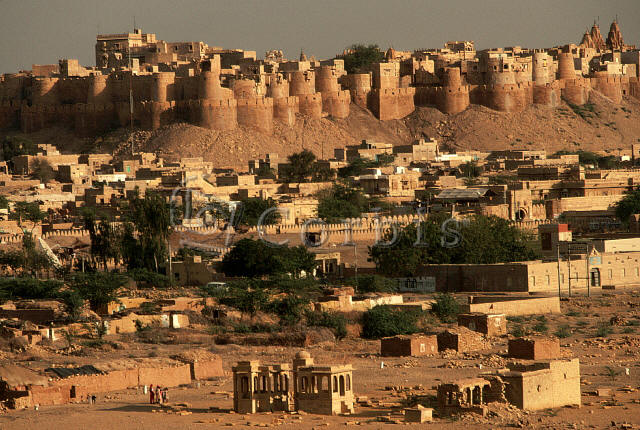
 Jaisalmer is situated in the western
Rajasthan region amid Thar Desert, close to Indo-Pak border. Like all other
cities of Rajasthan, Jaisalmer too has its own glorious past to boast about.
The city has an interesting legend associated with it, according to which, Lord
Krishna-the head of the Yadav Clan, foretold Arjuna that a remote descendant
of the Yadav Clan would built his kingdom atop the Trikuta Hill. His prophecy was
fulfilled in 1156 A.D. when Rawal Jaisal, a descendant of the Yadav
Clan and a Bhatti Rajput, abandoned his fort at Lodurva and founded a new capital -
Jaisalmer, perched on the Trikuta Hill. Since then it
continued to be on the focus of the masses because of its location.
It falls in the way of one of the two routes, which connected India from Persia,
Egypt, Africa and the west. Bahti Rajputs of Jaisalmer lived off the forced levy on
the caravans laden with precious silks and spices that crossed the territory en route
Delhi-or-Sind. These caravans earned the town great wealth.It developed
itself into a major tourist destination as well as a cultural hub of the western
India only after 1947, when the Rajputana royals
signed the agreement to remain in just independent India
 Like various other cities of Rajasthan,
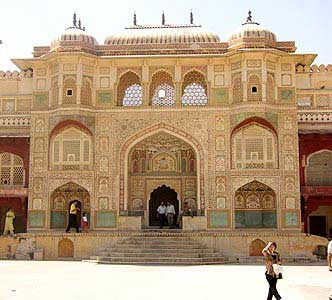
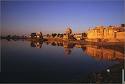
in Jaisalmer too you will find a number of heritage forts and palaces which
are both magnificent and royal in their own distinctive ways. Though you
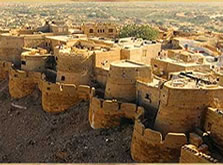
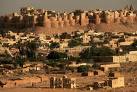
can find historical monuments scattered all over the city, the Jaisalmer Fort
will immediately command your attention. Made of sand stones and locally
known as Sonar Quila, the Jaisalmer Fort is a dominating structure
between the sands. The stone - craftsmen worked delicately on the
sandstone mansion, filling up facades with sculptural filigree, screen
windows, delicate pavilions and beautiful balconies. Today, these
veritable art - museums are still inhabited, and their colorful celebrations
and festivals have placed Jaisalmer Fort firmly on the world tourism map.
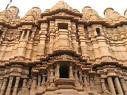
The Jaisalmer city is also revered for its Havelis. Among many others you
will find Salim ji ki haveli and Nathmal ji ki haveli the most striking ones.
There are other monuments too, which are equally important because of
there distinct and individual architecture. You can also visit Gadsisar Lake
and take a close look on the migratory birds as they indulge in amorous fight.
Or else visit Desert Cultural center to take a sneak peek of Rajasthani culture.
There is enough to keep you busy for days in Jaisalmer itself.
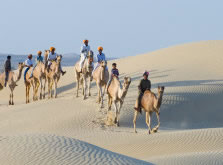 You can also choose to go on excursions
while you are in Jaisalmer. Some of the many places that you can
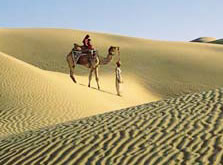
visit are Sam Sand dunes. You can stay in the camp in solitude and just look at
the sun setting behind the horizon. Or else you can also opt for Khuri sand
dunes and can get pampered by Rajasthani hospitality, listen to local folk music
and enjoy authentic Rajasthani cuisine. You can also visit Lodurva, the ancient
capital of the Bhattis and appreciate the Dilwara style paintings scattered all
around the ruins. Or you can also peek in to the history of this majestic place and
can choose to visit Amar Sagar or Bada Sagar and live the rich cultural heritage
once and forever. A visit to Fossil Park could also be a wonderful option.
If you are a conservationist, you can try your hands at the Desert National
park or opt for Phalodi for extreme solitude. There is so
much to see and explore in Jaisalmer!
Rajasthan Wildlife Travel
Ranthambore National Park
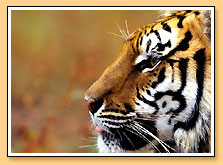 Ranthambore National Park is
one of the most popular National Parks in India.
It was conferred the status of a National Park in the
year 1957 and came under the ambit of "Project-Tiger" in the
year 1974. The park is strategically located in the midst of the
imposing Aravalli and Vindhya mountain ranges covering an area of
400 sq. kms. Of all the National Parks of India, Ranthambore is one
of the most picturesque with the backdrop of an invincible fort
located on a hilltop while the park is spread in the foothills.
The foliage is primarily of the dry deciduous kind interspersed
with shimmering wetland areas which offer the resident wildlife
species of the park with welcome relief especially during the sweltering
summer months when the temperature hovers around 40° celsius.
Ranthambore came into prominence because of its burgeoning tiger
population and in the mid 80's the tiger count stood at a healthy 40
plus which unfortunately is not the case anymore due to a number of reasons and
poaching is one of them. One distinct advantage that tourists enjoy
when they decide upon a safari holiday at Ranthambore is that the chances of
sighting tigers at Ranthambore is very high in comparison to other National
Parks because the quintessential Ranthambore tiger doesn't fear human
beings which is not the case with tigers elsewhere.
Sariska Wildlife
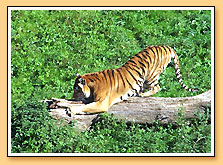 In the days of yore, Sariska used to be
the hunting ground of the Maharaja of Alwar. It was declared as a National
Park in 1955. The park is spread over an area of 479 sq. Kms. and isdivided
into three zones - core, buffer and tourist zone. In 1979, Project Tiger
initiative was launched in Sariska National Park. Sariska NationalPark is
teeming with wildlife and some of the resident species include
sambhar, nilgai, wild cats, wild bear, chital, four horned antelopes and a
variety of deer. The central point of Sariska National Park is the Pandupole
watch tower which is located 22 kms. inside the forest. The Pandupole
area is believed to be an area where the Pandavas took shelter during
their exile. A Hanuman Temple is located near the watch tower.
In Sariska not only can one marvel at the haunting wilderness but one
can also add a bit of culture into one's safari. For instance, there is the
Kankoyari fort, located 20 kms away from Pandupole where Mughal emperor
Aurangzeb had kept his brother Dara Sikho as a captive prisoner. If one goes
further ahead, there is the Nilkantha temple which is believed to be 1,500 year old.
Contact
SOLANKI RESTAURANTJodhpur Road, Uttarlai-344035 BARMER (Raj.)
prakash.sn09@yahoo.com
02982-242106
09414373251
Home Delivery Facility
In Uttarlai

TOUR
News
This section is empty.